Powered By Blogger

Monday, 4 June 2012

Avoidance and the Modern Yogi(ni)

"if you have a problem in your body, your body will naturally move away from it in order to avoid pain and discomfort"- Dr. Jason Skolar, chiropractor.


"tapah-svadhyaya-Isvara-pranidhanani kriya-yogah:
In order to practice being whole, an inner fire, constant study, and a devotion to things spiritual are required" - Patanjali Sutra 11.1, translation Kofi Busia


"By practicing yoga with a warrior's courage and an infant's vulnerability, we can embrace stiffness and flexibility, likes and loathings, the sunlit and moon-shadowed" - Ronnie Paul, Yoga With An Attitude, Yoga International Magazine

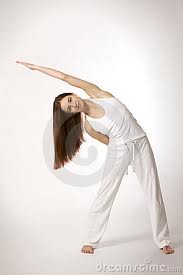
It has taken me awhile to process my 21 day trikonasana (triangle pose) challenge.  As a Yoga teacher, I will tell you it is neither my first nor my last.  I hold the belief that I cannot teach what I have not yet practised, so I often put myself into these challenges, to see what I can learn and at some point, my experience as a student of myself usually becomes fertiliser for teaching others.  I also believe consistency, ritual, and repetition are foundations of transformation.

I would probably never have written about this except I just recently saw a video "never give up"  which is about one man's journey into transformation through yoga....and I thought, yes, this is what it is all about. Not about "achieving the perfect pose", but about getting into the whole journey and persevering, moving past "can't".  There is always something we can do on and off the mat, and finding it and focusing on it is very transformative/productive.  Watch the video - you will understand.  And then there is a student of mine who insisted I take pictures before and after a one hour private yoga class.  You can see such change that maybe all of you who do not believe that your tensions can be teachers, that your tightness cannot be released, that yoga is only for the already flexible, maybe you will give it a go.  Below on left is before, and on right is after -one one hour session (yogatherapy).
What initiated the challenge this time was being in a workshop where we were asked to go into a posture we hated.  Hello! Right away I groaned and did a very lopsided and uncomfortable trikonasana.  I did not even bother to pretend my heart and mind were with me, I just grimaced on the inhale and complained on the exhale. It was not very NAMASTE.  Needless to say, I had avoided including this posture in any and all of 17years + of daily practise.

I do feel that avoidance can be a good thing: Montreal potholes, touching fire, walking alone on a dark street, foods that trigger bad reactions, negative and non-nurturing circumstances, driving on an empty gas tank, texting and driving, gossipping, being in the sun without sunscreen, forgetting water on a long walk...This however was a different kind of avoidance, of just letting myself get blocked by my own tightness instead of setting out on an exploration to overcome and understand.


At any rate, several variations later we had worked out a way I could try the posture, and at least breathe through the discomfort.  My first reaction was jeez why bother! I just want to feel good, but - my first response to that was, hmmm, let's investigate why it isn't comfortable.  That is what I felt I needed to do.  I mean - really - it is one of the classical standing postures and has all these benefits- who in their right, meditative mind would not want all this? :
-elongates and strengthens your spine
-brings flexibility to back muscles
-tones legs
-helps balance liver, kidney, spleen function
-powerful pose that can help build strength/determination.

Week 1 was not too easy.   I hated trying to breathe into a very uncomfortable right hip. I hated being tight.  I thought I should be a model for Yoga Journal not feeling like the only Yogini on earth to be leaning on a wall in order to get to the other side of this investigation.  However, I kept at it, making sure I was warmed up enough to hold it for about 1.5 minutes per side, breathing comfortably and steady on my feet.  Relaxed while monitoring and being aware of tension is VALUABLE.  I learned a lot about pain signals and discomfort.  These are important cues for instinct management in daily life, don't you think?  The body has a language of its own, and the breath is a barometer of stress/emotions. The thoughts and feelings that surfaced were interesting to me, and I journalled a lot to bring stored tension to light.

Week 2 was less physically uncomfortable.  I moved from the wall variation to the support of two blocks.  I discovered I had been trying to move into it with the wrong part of my anatomy because of certain weaknesses.  I discovered that what propels me forward is not focusing on my strengths, but improving these weaker, tighter parts with ahimsa (loving kindness).  I found that bit by bit the body was opening its doorways.  There was a moment when I thought ok, well I got what I came for, let's move on...but 21 days means just that.  Onward.

Week 3 was so informative.  I had a rhythm by then, my body looked forward to the stretch, and I noticed my mind, not having to focus on tension -past, present, future- experienced the sense of meditation in motion where you are not so much "doing" the posture as "being" it...I call it effortless effort.  Frankly, I have better mobility than ever and have let go of so much tension, I feel much freer overall.

I have arrived at the point where I can leave the discipline of 'having' to do this posture, and now am staying present when I practise, not simply to what variation will work for me, but whether it is a necessary choice in that moment.  I think avoiding based on laziness, fear or 'certainty' of failure is not an option for me.  My tensions have been the bearer of some great wisdom for me.  I wish for you the same positivity on your journey of transformation.  Stay safe,

Om shanty shanty shanty,
Rana


Friday, 1 June 2012

Staying Fit With Cancer, a Guest Blogger's Approach


Dear readers, I am happy to share with you an email and article written by David Haas.
He recently contacted me and I am honored and excited to post this on his behalf.  Cancer has touched my personal and professional spheres in different ways - perhaps yours too- and
awareness is healing on many levels - support, prevention, cure..

Hi Rana,
I stumbled across your blog and noticed the great content on your site. I am wondering if you allow guest posts because I recently have been researching and writing about how beneficial cancer support networks and also staying physically fit is to people going through treatments, in remission, and even family members of cancer patients.  I believe an article on one of those two topics would mesh with your blog very well and also benefit your readers tremendously. This is an important message to get out there so please let me know if you would be interested in seeing it and sharing it with your readers.
Thank you for all you do in making a difference,

Staying Fit With Cancer
There is no doubt that being diagnosed with cancer is one of the most difficult and trying times in a person's life. For many, there are visions of pain, suffering, and a sense that life is over. It is extremely important to recognize that this is far from the truth. Having a relaxed and positive mindset is a very important aspect of dealing with cancer and it can go a long way in helping you fight it. Today, modern medicine has helped many survive cancer after being diagnosed. Thinking positively and relying on modern medicine are just as helpful as it is to stay physically active. Many studies have found that exercise can aid in recovery and even keep cancer from returning.


If you have just been diagnosed with cancer, there is undoubtedly some uncertainty and fear in your life. It can be difficult to acknowledge the diagnosis. If you led a healthy and active lifestyle before your diagnosis, continuing this behavior will be one of your best defenses. At this early stage it can be helpful to find a support group to guide you through any emotional stress. This will help you to continue daily life and maintain your healthy exercising habits. However if you do not already exercise or practice yoga, beginning to do so will ultimately help in the fight against cancer. The benefits  of exercise are immense. Over time, blood pressure will decrease, endurance will increase, stress will minimize, and energy will be higher.


Going through treatment and surgery to treat your cancer no doubt take a toll on the body. These combined with the symptoms of the cancer, make staying physically fit a low priority. For example, people with mesothelioma, cancer of the lungs, abdomen, or heart, experience symptoms such as fatigue and shortness of breath. Combining this with chemotherapy and radiation can make exercise very difficult. It’s important to maintain a positive attitude and remember that exercise has health benefits that include increasing your chance of becoming a cancer survivor.


If you are a cancer survivor, one of the main priorities in your life is to stay in remission. Surviving cancer is a huge accomplishment. Celebrate by keeping your body fit and remaining healthy. Studies show that maintaining fitness not only helps prevent cancer, but keeps it from returning as well. Start off slow. Some light stretching or yoga might be a good way to start. Then you can work your way up to more rigorous exercises. Ideally, you should aim for doing both aerobic and strength training exercises. Therapy and treatments make you fatigued and you lose a muscle as a result. Aerobic exercise increases endurance and boost energy, combating fatigue. Strength training exercises increase muscle mass and help combat osteoporosis. Any way you look at it, the benefits of exercising are tremendous. Take charge of your life and your body and help it stay cancer free.


Your body is a wonderful machine that deserves special maintenance and care. Staying fit is an excellent way to help your body function at its peak, maintain higher levels of energy, and combat symptoms of cancer. Chances are that your doctor will recommend an active life style whether just diagnosed with cancer or in remission. Listen to your doctor and all of the scientific studies. If you do, chances are that the exercise will help you in keeping cancer from coming back.

Tuesday, 29 May 2012

Transition and the Modern Yogi(ni)

anitya-asuci-duhka-anatmasu-nitya-suci-sukha-atma-khyatih-avidya:  Ignorance is the confusion of the temporary with the permanent, the pure with the impure, anguish with the pleasure of being, and the relative with the absolute - Patanjali: Sutra 11.5, B. Bouanchaud, The Essence of Yoga


"If you are doing anything big and worthwhile in life, you are going to flush up some uncomfortable feelings" - G. Hendricks, K. Ludeman, The Corporate Mystic 


"It takes a brave heart to deeply accept that everything changes" - Judith Lasater, Living Your Yoga


I ran into someone today and after I asked "how are you?" this person blurted out: "I'm in transition".  From the intonation, I got the feeling that the transition zone was perceived as a place of uncertainty and unease. A separate sphere of struggle.

As we parted, I reflected on the conversation and my first thought was,  we are always in transition or in contact with it in one way or another.  Nature is our first mirror; sunrise to sunset, waxing and waning moon, conception to pregnancy to birth, childhood to adulthood to death, seed to tree, seasons.  We witness transition on a daily basis, but when in a new phase, there is a tendency to feel lost and sometimes very worried - "when will this be over?" "how will I do it?"...we become one with the confusion of foreign circumstances instead of with an inner knowingness that 'this too, shall pass' because it is part of the whole.  Then somehow, we are prepared or we prepare ourselves, we cope, master, muster, muddle and make it.  This despite not always having the end in sight.

I see students through life transitions and feel quite privileged to witness huge transformations.  For some people, feeling lost or not at the next step of the journey, provides an opportunity to seek reconnection or new aquaintance with inner guidance.  The system of Yoga is really an awesome choice for this;  from the internal practice of meditation to the external attitudes towards self and environment.   If you are faced with the transition from marriage to divorce, job to job-seeking, breakdown to breakthrough, grief/panic/loss to equanimity, insomnia to inner rest,  finding a way to be peaceful and at ease in the wholeness of your present moment provides a clarity and inner strength, a resilience and an inner resourcefulness that anchors you.  And, let us not forget, surrender...

I know it is not always easy.  I think about this every March because here in Montreal, the crocuses and tulips start to peek through the ground which is not always fully thawed.  How hard it must be for these flowers to sprout and be colourful amidst the gray of our not always finished winter.  Yet, they push forward and it all works out.  I am sure not all of them bloom but for the most part, Nature has both the challenge and the reward of growth built in.

We kind of have to be warriors in life.  Spiritual Warriors.  This is not a reference to fighting per se, but certainly to perseverance, and determined inner strength.  Virabhadrasana (Warrior Pose) in its variations actually refers to the dialogue in the Bhagavad Gita, and is more of an ideal for the practitioner, who exhibits bravery in the battle with the universal enemy of self-ignorance (avidya), which in the Yoga system, is seen as the ultimate source of our suffering - if we only felt at one with where we are and who we are without feeling disconnected from the Source...


Ten things you can try if you are in a transition are:
1. Practise "let go and let God" - show up, do your best, let the universe do the rest...
2. Simulate - who is it or where is it you want to be?  what are the attributes you can simulate now?
3. Inhale full, exhale with the Aaahhh sound...deep sighs help to train you to hear your own voice
4. Before you go to bed at night say thank you for one thing
5. Practise listening to what you are hearing as guidance (buy kale, go to the gas station, update CV, say hello to someone, connect on Linkedin, whatever it is that comes up: witness, hear, listen and act.
6. Get out and do one new thing, movement of any kind trains your brain that you are not stuck
7. Try a relaxation practise
8. Sometimes if you are in transition, less advice is better, or just the 'right' advice...it's OK to be protective of new growth
9. Honour and accept yourself as you are where you are...there is usually a beginning, a middle and an end to each cycle before a new one starts
10. Try YOGA :-) the whole system, but for now - a little experiment, it does not have to look like the photo:

Simplified directions for Warrior 1 (Virabhadrasana1) 
-stand tall and straight in Mountain Pose, legs parallel
-step one leg forward, while keeping the back leg straight, rooted through the heel, and slightly angled
-exhale and bend front leg without lunging forward
-keep spine vertical
-inhale raise arms to align with ears or where comfortable for your shoulders or just resting them
-tuck pelvis under, and by pushing into feet, feel the upper body become light and free as you reach up through fingers
-breathe steadily for about 10 breaths, comfortable in balancing with one leg forward, and the other leg back then repeat on other side...process by standing still after...

how did that feel?

Om shanty shanty shanty
Rana


Wednesday, 23 May 2012

zen and the art of summer living

"A healthy life is a life in balance.  Yoga practise offers an opportunity for learning about dynamic balance.  Maintaining mind-body balance provides the best platform to make karmically correct choices, enabling you to perform actions in the most efficient way.  A life in balance is a life in dharma, for every action supports the evolutionary flow of life in which minimal resistance and maximum success are generated" - Deepak Chopra, The Seven Spiritual Laws of Yoga 


Every summer I get new business as people injure themselves from some preventable situations...so I have decided to give some simple tips to keep everyone out of as much trouble as possible.  Life is so much easier if you do not ignore your weaknesses and/or add a bit of mindfulness to break out of auto-pilot.

To all you gardeners out there, if you have knee problems, spending a full day on your knees may not be the best thing without some kind of padding underneath you.  Even folding a yoga mat or gym mat and placing it under your knees can be good, you can hose it down later.

Golfers, I do not play but I did get a student to bring in a golf club so I could watch him swing it, and I do believe some yoga beforehand can limber up the spine and truly focus you for game time.  It also helps with all the self-criticism.

Cyclists, I love my bicycle...but seeing people without a helmet makes me nervous. It is a law here in Montreal.  It is more life affirming to wear one than to be cocky and say "nothing is going to happen to me without one"

Swimmers, well yoga has definitely changed my strokes for the better, much more open in the shoulders, and I am also a great breather.  What I highly recommend is getting comfortable with a slower exhalation. Panic is not a swimmers BFF, you want to learn on-land how to stay calm before you go into a pool, lake, ocean or go snorkeling...


Barbeque-er's, yumm! What can I say about overeating, it is fun, but with the heat, too much food, and spillover stress, the digestive system may not take kindly to it.  Enjoy yourself, but practise watching for when you are full, then pack it up as leftovers.  Everyone wants to know how yoga can help with weight loss - well this tip is numero uno.

Walkers, I love walking.  Great way to connect to nature, hear yourself think, get some quiet time.
You can try a walking meditation, just slowing it down with nature's music, listening to your breathing, and going step by step...


Flip Flop wearers, gotta love flip flops, just know they have no support so feet, knees, lower back are not going to happy...at least find a way to safely elevate your legs, do foot circles to keep joints limber

Joggers, posture-wise, let the hips do the running - having rounded doopy shoulders adds unnecessary pressure to your spine plus likely slows you down.  Activity should be balanced with rest.


To all you "I want to meditate but have no time"ers - there is nothing like watching a sunrise or a sunset, or rainbow.  Nature is always giving us moments to feel grateful, open, priviledged.  Instead of looking, try seeing.  Meditation cultivates the witness, psychological distance, emotional balance and lots of great stuff.  If you are given the opportunity, take it instead of turning your back on it.

Stay hydrated.

Be optimistic and prepared.  There is nothing like a deck of cards, a notepad and pen, a book, magazine or article...

Watch your purse or wallet.  You can trust your family and friends, but in a foreign country stay present and alert.


Use summer time which is typically a 'relaxed' season, to actually learn how if you don't have an on-going practise. Relaxation is not being a couch potato, contrary to popular belief...there are tips, techniques and tools but it is safe for everyone and actually everyone needs it.  Yes, even you.


Even writing down a wonderful experience is positive, and perhaps will serve you in your visualisation practise.  Some people call it a gratitude journal, you may find you want to blog - I don't know, but if it feels creative, likely it is a good option.

Happy summer

Om shanty, shanty, shanty
Rana


Friday, 18 May 2012

Body Language and the Modern Yogini


"Pain has a definite way of getting our attention.  It is difficult to deny deep pain.  All our attention goes to that place. Yet in deep sleep it seems to go away or lessen." -Nischala Joy Devi, The Healing Path of Yoga 


"Mindful awareness has this great capacity to free us from the self-imosed limitations of our fears and thoughts." - Tara Bennett-Goleman, Emotional Alchemy


Learning to listen and respect your body is a process that requires patience and compassion.  I taught yoga to a marathoner recently and one of the things I said was, the physical practise of asana is not mind over matter, like pushing yourself to excruciating lengths to cross a finish line.  Yoga is mind in matter, the breath and focus on synchronicity between breath and movement is a holistic involvement.  Our honesty and authentic self is revealed through this practise and we listen inwardly.  If our hamstrings say, "I am too tight, this is my edge", we respect them, and back away a bit.  We learn to distinguish pain from discomfort, and it is not always straightforward.  Pain can be sharp or dull, an ache, a "NO" and it can be quite uncomfortable.  It can be a symptom of a health concern you should get checked medically, and it can be psychological and emotional, stored in the body and masquerading in your neck, lumbar spine, hips... Discomfort can feel like tightness with possibility.  With a bit of stretching, focused breathing, an intention to move into comfort, some discomfort can shift.  It is really personal as well.  You may see glimpses until you get the full picture, as it is a process.

People initially confuse listening to the body to listening to the mind with all its frenetic "I shoulds"...With time, you become inwardly sensitive, and a connoisseur of sensations.  How deep you go is relative to what you feel, and to what you know.

How to hear the messages from your inner guidance system can be a practise on its own, with rewards that spill over into daily life, as instincts are key to positive, nurturing choices, to our health and to our safety.

Here are some points to consider being attentive to:
1.  Make notes of anything in your life that is difficult, painful, joyful, and notice how your breathing, heart rate and other bodily sensations respond to each of these.
2.  Pay attention to what your body feels like.  For example, do you feel fluid, numb, like crying, stuck?
These feelings are your body's wisdom; clues in your inner guidance system.
3.  When you experience a bodily sensation such as "gut reaction", back pain, a headache, a stomach ache, pay attention to it.  Are emotions such as anger or fear connected with any areas of your body? When a sensation arises, stop, lie down, breathe and wait with the emotion or sensation - what insights come up through this process?
4.  Notice how you routinely talk to yourself.  Do you chastise or appreciate when you look in the mirror? Are you hyper critical or do you give your body positive messages, and gratitude.  Your body digests meals, breathes in and out, and your heart beats 24/7...Cultivate a positive chain between your inner mental dialogue and the rest of you.
5.  Understand that you risk your health when you consistently undermine your body.  Burning the candle at both ends, worrying incessantly, food choices, activity choices, friendship choices...it all affects our system as a whole.


You can start the unconditional love and acceptance for yourself by:
1.  Standing in front of the mirror, affirm:  "I accept myself unconditionally right now.  I love my body and I love myself just as I am".  Try this 2 times a day for 21 days.
2.  Learn how to breathe to create inner calm.  A simple practise is to inhale to a slow count of  3 or 4, exhale to a slow count of 6 or 8 (adjust as needed).  Try this minimum 5 minutes per day for 21 days.
3.  Remember that the "attitude of gratitude" is what brings an inner and outer smile.  About 90% of our bodily functions take place without you the personality telling it how to do the job.  Acknowledge that your body today grew from a glint in your parents eyes, and is quite a miracle.

You are beautiful inside and out, let me know how you progress!
Om shanty shanty shanty
Rana


Friday, 11 May 2012

Challenge and the Modern Yogini


"Aversion is the consequence of displeasure
duhkhanusayi dvesah" -Patanjai- Yoga Sutra 11.8


"Repulsion, or aversion, is based on past experience and the mental permeation that follows it.  Whether conscious or not, it remains sealed in the memory, taking no account of the way the situation has evolved". - Bernard Bouanchaud, The Essence of Yoga 


"Consistent asana and meditation practice will improve the way your energy flows, and this will change the way you experience yourself - transforming the way you perceive and relate to the world" - Erich Schiffmann, Yoga:  The Spirit and Practice of Moving Into Stillness


"This pose elongates and strengthens your spine, brings flexibility to your back muscles, increases circulation to your pelvic region, and tones and improves functioning of your reproductive and digestive organs.  It also calms your mind and relieves anxiety and nervous tension - Patricia Walden:  The Woman's Book of Yoga and Health


This week I decided to start a 21 day YOGA challenge of Trikonasana, triangle pose.  It is an asana I never cared for, never really felt it had any place in my daily practise.  I realise since I started it that one of the reasons for avoiding it was some big discomfort in the right hip.  The path of avoidance led to a huge compensation on the left side, and pretty interesting weaknesses and muscular restrictions on the right.  Hmmm. 


At first I must admit, the dialogue in my mind was pretty much: "what is the point of this?!" "It's not yoga if you aren't breathing!!" and basically lots of re-focusing on steady breathing and finding the point where I felt I was opening my body, not in dramatic ways, but just a bit of light, like when you open the curtains in a room. I have to say, I am practicing bit by bit and my body and attitude are really changing. The tension is lessening. I warm up well for it, and use the variations with support (wall, blocks) that make me feel as organic in the challenge as possible. I find a place I can relax into.  My teacher calls it effortless effort, like Nature...crocusses pushing up through cold soil, know how, somehow, to break through the earth even when it is still cold from winter.

Today I actually heard my weaker side thank me for discovering it, and I heard my body laugh, "the issues are in the tissues!!" So true.  I find there is a way to go through a challenge without stressing yourself more, you know? Do your best, go step by step, honouring yourself each step of the way.  I do not chastise myself for what I do not look like in a posture, or what I cannot do. I do not compare, compete or contrast.

However...I had a conversation with a close friend who is going through some really tough circumstances which are triggering his insecurities.
He was saying things like "I just can't do it! I am not good at it! I want to give up!"  How interesting that my challenge on the mat parallels and illuminates what we go through in daily life.  


People say "Be positive!"  "Focus on the positive"  "Play to your strengths"...All good, but somehow not holistic.  I find that pushing our weaknesses away just makes them weaker.  Our strengths compensate and can create huge imbalances for us.  I prefer to just do my best with what I have, see if I can improve, delegate or get support (like we do with yoga props) if it will help me.  


I like to try everything I can to improve and reach higher.  I am not really type A I think, just an excellence seeker. I also believe there is always an "I can do it" in there even if my way is not the same as someone else's.  I am fine with being unique.  I hope you are too.  I hope you find a safe way to reach inside and find the strength and light to observe an area of yourself or your practice that
can be improved, opened, honoured, accepted, stretched, breathed into, nourished.  

Let me know how it goes...
Om shanty, shanty, shanty 


Monday, 7 May 2012

Silence Empowers.


"Close the eyes gently and look down within at the heart without hardening the eyeballs.  This inner observation or feeling is most revealing" - B.K.S. Iyengar, Light on Pranayama


"The feeling of stillness is peace and the feeling of peace is joy.  Therefore, come back to the center and feel the joy.  Do this frequently throughout the day" - Erich Schiffmann, Yoga: The Spirit and Practice of Moving Into Stillness

"When all desires are in peace and the mind, withdrawing within, gathers the multitudinous straying senses into the harmony of recollection.  Then, with reason armed with resolution, let the seeker quietly lead the mind into the Spirit, and let all his thoughts be silence - Bhagavad Gita

Sometimes hearing takes place without listening...


If you are a parent, you might relate.  You tell your kids to brush their teeth.  They say "ok", so you know they heard you, but you have to repeat it in escalating vocal tones until you are at 10 and then they tell you "I heard you, you don't have to yell".  So yes, their sense organs, function but this did not translate into listening.  Sometimes as a Yoga teacher I give directions 3 or 4 times.  I know I verbalised them, but somehow, they are not being followed.  Segway to the expression "red flag" which deserves honourable mention here as well.  You know, those times when your instincts are whispering/telling/screaming at you to buy those stocks, sell those stocks, fire employee x, don't date Mr./Miss Wrong ....and what attention do you pay?  Well, you don't.  Why is this? Noise surrounds us and then penetrates us until our minds are speeding faster than a tweet.  Silence is a visitor when we go to sleep, unless our dreams are active, then we don't wake up rested.   We need to carve it out as a practise to reap its rewards.


Now, I am not anti-music or talking - I am just pro-silence.  Here is why:
1.  Silence fosters CREATIVITY.  New ideas are not found in a brain juggling a gazillion thoughts. An over-worked brain just leads to thinking within the box, and confusion.  When the mind is still, there is no box.  Inspiration floats in this freedom..
2.  Silence builds confidence. If you go mindfully and give yourself time to trust your instincts and listen to your own voice, you empower yourself.  The "shoulds" of a noisy brain are distracting you from being in charge of yourself.
3.  Silence rests the brain and body.  Growth hormones and endorphins circulate and percolate in deep, dreamless sleep, meditation, and these are silent states.  Your body does not uses words to heal from injury, DNA knows what to do.  It got you this far.
4.  Silence invites "being".  We are called human beings not human doings.  We are active enough, let's balance it out.
5.  Silence anchors us in the present.  Life is chaotic enough.  Feed the stressful thoughts and that will grow.  Nourish a silent inner core and you will be resilient through tough times, peace will guide your attitude.
6.  Silence is your BFF.  You get to know your Self, get in touch with your own emotions.  You don't have to wear a mask in silence.  Pretty relaxing.
7.  Silence promotes listening.  A good listener, hears you and 'sees' you through the ears. It is a compassionate understanding that starts with the self, and then builds healthier relationships.  Even if the most unhealthy relationship you have is with potato chips and you really want to break up but don't know how.
8.  Silence is your GPS.  Answers to all your questions are found in the light of silence.
If you are too busy talking and thinking a mile a minute, you will only feel lost.  Feel Found.


How to? I realise it is hard when you live with people.  You may have to get them on board;  can you start with 3 to 5 minute plan?  Sit quietly, breathe softly and give your breath all your attention, do not generously follow thoughts or emotions, follow the stillness.  Or, take a walk in nature with no music for the first 3-5 minutes.  Do not turn on the car radio for the first 3-5 minutes.  When you wake up, turn the radio off and just do your thing to the tune of your heartbeat.  Try this for one week.  See what grows, and let me know!


Om shanty, shanty, shanty,
Rana